Robots Edition
Whose embodied aesthetics are accepted as computable and worthy of credit ?
This page details our first five-day residency at Brown University’s Humans to Robots Laboratory.
During the residency, we examined how Boston Dynamics’s Spot robots are already designed to embody dance through the Spot Choreography SDK. We examined the SDK as a digital movement archive and adapted tools and practices from dance improvisation and somatic practices.
Our process enabled critical intimacy and revealed assumptions, limitations, and power dynamics encoded within Spot’s robotic infrastructure.

Quick Links
Residency Blog
•
Residency Blog •

Day 1
First Contact:
How do we build mutual understandings of technical systems through applied practices in dance and robotics?
On our first day we established daily rituals for our collaborative process which grounded our shared practices. We then spent the most of the day on a technical orientation of Spot. We learned how to navigate the software, safely move hardware, and program Spot to dance.

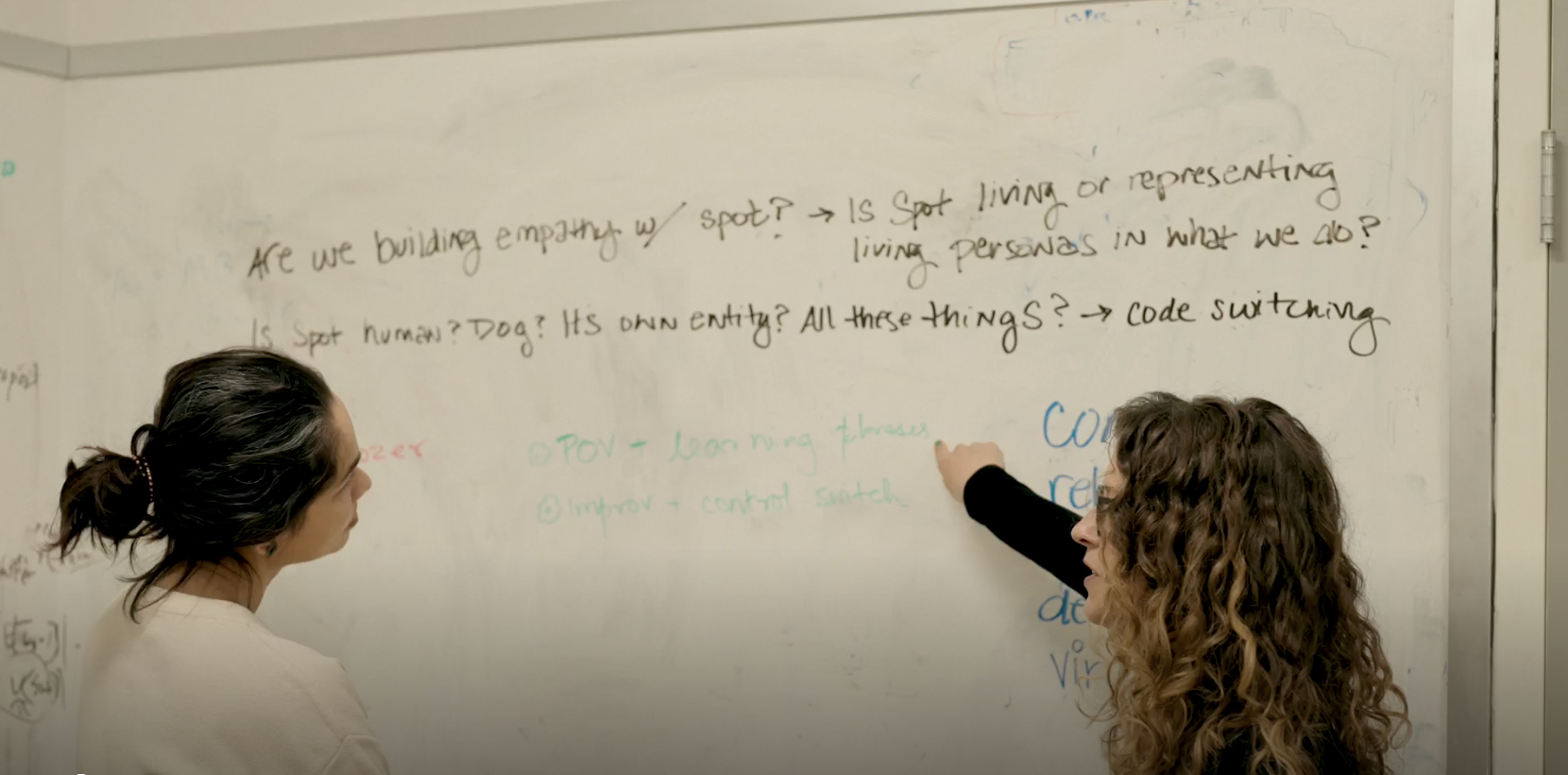
What are the effects of humanizing Spot?
Activities
Establish daily rituals to cultivate meaningful collaborator relationships.
Create a research altar to hold meaningful items from each collaborator.
Review Spot’s robotic system
Spot Choreography SDK, Standard Operating Mode.
Formalize safety protocols using robotic safety recommendations and theatrical communication safety protocols.

What stood out
The group unpacked the cultural and technological implications of Boston Dynamics' Spot robot, particularly its role in dance and virality. Boston Dynamics received military funding, which supported early robot development. Later, Boston Dynamics boosted company popularity and visibility by making viral, online videos of their robots dancing. Tracing this lineage, we discussed how cultural capital has been acquired by dancing with Spot. For example, high-profile pop stars like K-pop band BTS and Katy Perry have benefited from their robo-collaborations, which paint them as technologically savvy, cutting edge, and well connected.
In practice, we found ourselves repeatedly humanizing Spot, which brought up big questions. Is Spot just a tool? What happens if we humanize Spot? We did not land on a definitive answer or position as to whether humanizing robots is inherently good or bad, but the question lingered throughout the week

Day 2
Deepening Understanding:
How does deepening our understanding of complex systems inform our awareness of their biases, rhetorical norms, and cultural impact?
On our second day, we unpacked each of the major components that make up Spot’s robotic system and Choreography SDK. Through this process we discovered the ability for one controller to take robotic control away from another controller without asking permission. This is done through the “highjack” feature. Our discovery led to a rich discussion about the rhetoric of highjacking as it relates to power, agency, and control.

Hijack game
To explore further, we developed our first improvisational score to examine the feeling of highjacking. One person stands in the middle of a circle of other people. Someone standing around the circle says “me” and begins improvising movement. The person in the middle of the mirror turns toward the speaker and mirrors their movement until another person takes control by saying “me.” The person in the middle then turns toward the new controller and mirror’s their movement.
Activities
Deepen our understanding of Spot’s robotic system–Choreographer Interface, handheld controller, physical robot body, robotic sensing system.
Develop an improvisational score where the team took turns operating Spot, as a way to understand control structures.
Develop an improvisational score to embody Spot’s “highjack” feature.


End of day
Our first improvisational score initiated our collective practice of embodying robotic system features toward a deeper awareness of how practical choices to support system efficiency and effectiveness are laced with rhetorically and behaviorally complex practices that carry very different meanings outside of robotic contexts.

Day 3
Embodied Connection and the Precarities of Humanizing Robots
How does tactile intimacy build embodied connection, and is an embodied connection with robots something we desire?
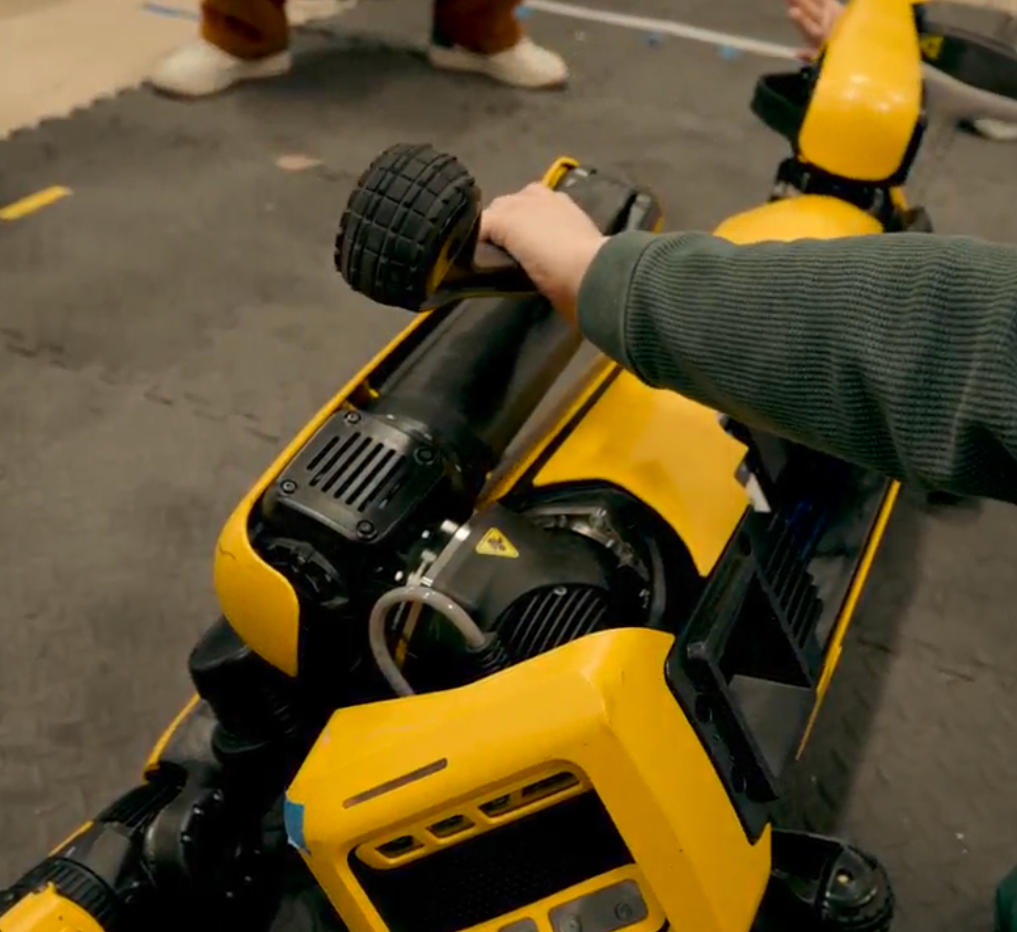
As we became more comfortable, we built a physical understanding of the robot’s hardware by powering down Spot and physically moving its limbs and body. We situated our approach within an improvisational framework using Skin, Muscle, Bone - a touch-based improvisatory practice.
As each of us moved Spot’s limbs, we used this terminology to articulate our experience, immediately noting that the passive motor resistance of Spot’s limb joints felt similar to gravitational pressure.
As we moved Spot’s limbs, we questioned our own impulse to treat the machine with care.
As we discuss in our MOCO 2026 paper, “Are robots companions? Helpers? Tools? Friends? The range of applications for a robot like Spot is broad. For example, Spot is currently used to maintain system checks in industrial facilities, assist in policing activity, and dance on camera.”
We found it easy to humanize Spot, yet we acknowledged that treating Spot as anything but a machine could be dangerous. Embuing Spot with human-like agency obscures the human control required to make the robot function — the humans are often hidden from view in Spot’s viral dance videos and demos. This imbues Spot with a sense of autonomy that the robot does not possess. And yet it does.
Activities
Build intimacy with the robot while powered down using an improvisational exercise called Skin/Muscle/Bone.
Is caring for a robot dangerous?
“Popular culture’s fascination with robots as replacements, replicas, and stand-ins for people complicates the perspective that robots are merely tools. It also impacts robotic development as we see more and more companies attempt to mirror human movement and anatomy in robotic systems.” (MOCO 2026)
We never reached a definitive answer as to whether caring for a robot was dangerous, but the question continued to linger as the week progressed.
Day 4
Collaborative choreography and Translation:
On the fourth day, we tried co-choreographing with Spot to better understand how dance and robotics knowledge and expertise intermingles to create robotic movement. We worked with Bill T. Jones’s improvisational structure from Floating The Tongue and engaged all Four Phases of Jones’s choreographic structure. We discuss our approach in our paper for the 2026 MOCO Conference Paper.

How do we translate our embodied histories into robotic systems, and what is lost (or found) in the process?
Each team member choreographed or selected a movement phrase—a historical dance, personal choreography, or movement exploration. This is discussed in our forthcoming paper for Intermédialités.
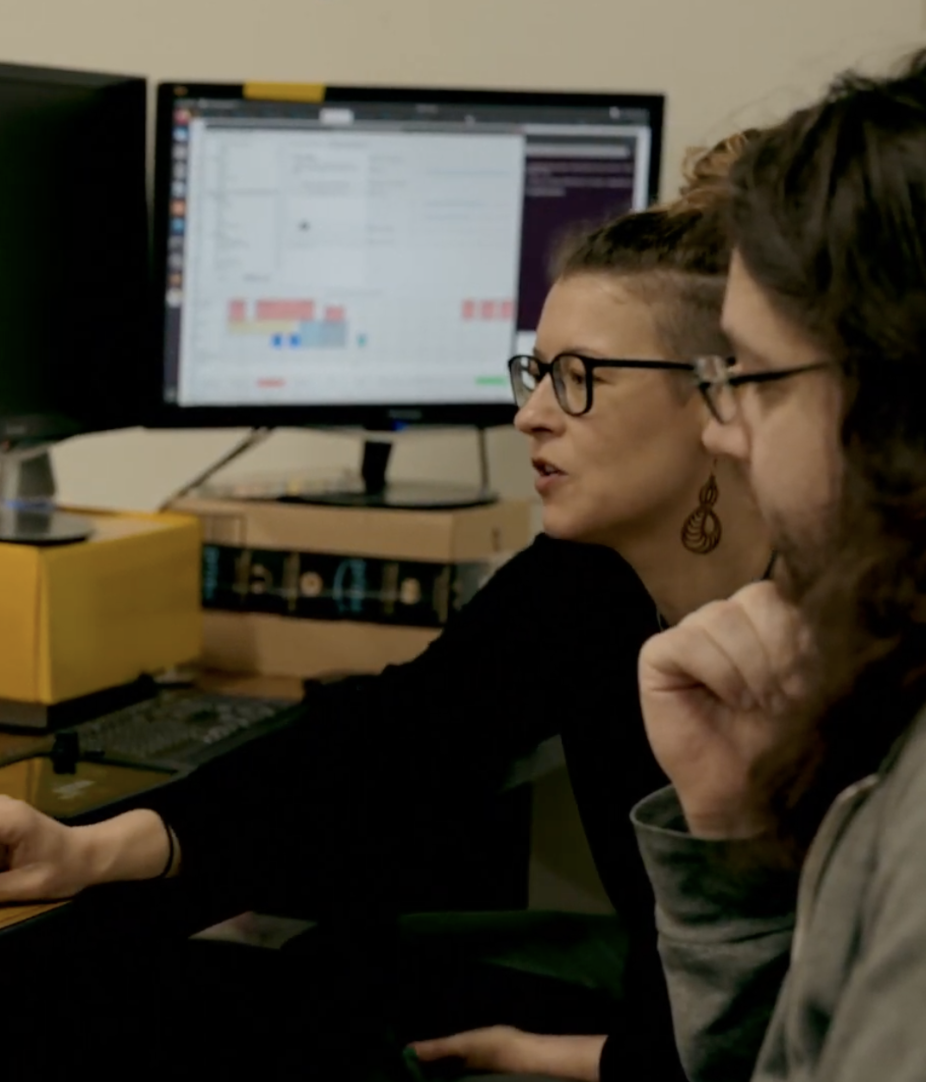
We then translated our movement phrases into the robotic system using the moves available in Spot’s Moves Library. This translation process allowed us to directly contend with the expertise, aesthetics, and embodied values of the Spot Choreographer SDK designers.
Once our movement was translated onto Spot, we watched Spot perform our movements and spoke out loud what we saw. Listening to team members describe Spot’s actions gave us insight into the disciplinary, cultural, and personal biases we each hold in relation to our work.
Activities
Review, Discuss, and Improvise with Bill T. Jones’s Floating the Tongue.
Review, Learn, and Dance each team member’s speculative move.
Translate each person’s speculative move onto Spot using the Choreographer GUI.

:


Day 5
Document and Debrief
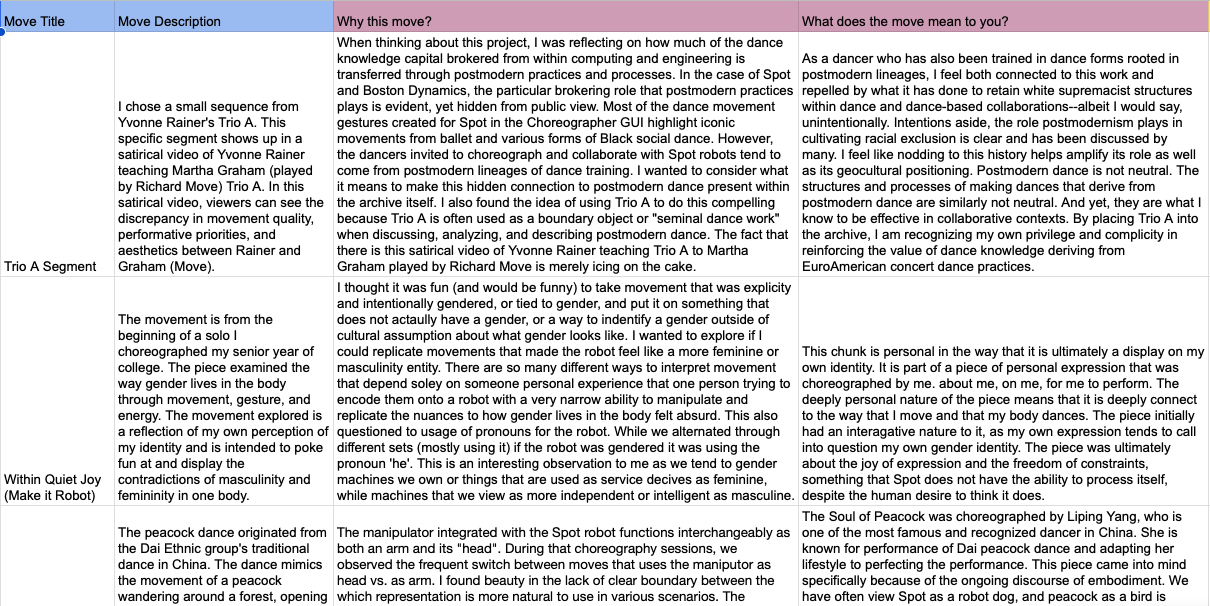
Documentation is vital. On our final day, we indexed our choreographic process and documented our experiences. Central to our documentation is the Speculative Moves Library. The Speculative Moves Library is both a record of how we translated our movement onto Spot on Day 4 and a provocation toward what should be documented when robotics teams integrate dance knowledge into robotic systems.
We realized we desire more transparency when dance is integrated into robotic design—not to assign blame, but to understand how decisions unfold over time. We spent the afternoon writing our entries into the Speculative Moves Library by answering questions like: Why this move? What does it mean to you? Who did you collaborate with? Our responses are all compiled into the Speculative Moves Library spreadsheet. We talk much more about this in our forthcoming paper for Intermédialités.
To document our research choreographically, we created “The Chunk.” The Chunk is a robotic dance of our collaborative research. It is composed of our personal movement phrases translated onto Spot on Day 4. Instead of music, we used the audio recordings of ourselves speaking out loud when watching Spot dance to create the soundscape for Spot’s performance. (Note: We used Phase 3 and 4 of Bill T. Jones’s Floating the Tongue to inspire how we spoke aloud.)
As we watched Spot perform “The Chunk,” we reflected on how a singular, dancing body — human or robotic —requires multiple bodies to assemble, collaborate, ideate, and translate their efforts onto one form. We also reflected on how artistically challenging the creative limitations of the Spot Choreographer SDK is itself a unique form of system critique that exposes system limitations and bias through performance.
Activities
Document the origin, intent, and translation process of each move in the Speculative Moves Library.
Create "The Chunk" by assembling individual movement contributions into a single, robotic dance phrase.
Debrief about our residency work and its impacts.
The Chunk

Portfolio
•
Portfolio •
Choreographic and Improvisational Approaches To Interrogating Robotic Systems
The Decoding Digital Bodies project is a transdisciplinary initiative that examines how human movement, particularly dance, influences technology research and development beyond visual representations of the human form. This paper introduces the Robots Edition of the project, in which the Boston Dynamics Spot robotic system and its Choreography SDK serve as the boundary object of study. Through three examples of choreographic and improvisational practice, we demonstrate how dance practices: 1) exist within the robotic system and 2) provide novel methods for critically probing complex software/hardware infrastructures. This work contributes to human–robot interaction by demonstrating how dance-based inquiry reveals underlying assumptions in robotic systems and provides new modes for critically engaging robotic systems.